PRODUCT REVIEW: Exo-Terra Breeding Boxes

I have been keeping tarantulas for over 40 years and am always looking for better ways to house them. When I first started your only real choice were glass fish tanks. These were ok but heavy if you had to move them (and you have to also remember that tarantula guides from the 70’s recommended using fish gravel as a substrate adding to the weight). Next came the Critter Keepers, plastic enclosures with snap on, well-ventilated lids. I started using these and have been happy until the last few years, where the plastic used for the lids has gotten more flimsy, preventing the stacking of the enclosures. Thankfully Exo-Terra has come up with a solution in their Breeding Boxes.

BREEDING BOX1

Continue reading PRODUCT REVIEW: Exo-Terra Breeding Boxes

BOOK REVIEW: “Millipeds In Captivity: Diplopodan Husbandry and Reproductive Biology”

One of the most difficult things in being an invertebrate keeper is finding good information on the very animals you are keeping. Sure you can do a Google search and find pretty much anything you want but then you have to ask yourself, “How reliable is this information?” What is the source? Is this information good for keeping an animal alive for many years or just a few months? Good, reliable information is hard to find, especially when it comes to animals that may not be as widely available as something like a tarantula.

MILLIPEDS7

Continue reading BOOK REVIEW: “Millipeds In Captivity: Diplopodan Husbandry and Reproductive Biology”

The Molting of Nhandu chromatus, the Brazilian Red and White.

The act of molting is a usually stressful process that invertebrates go through to grow. Since they have a hard exoskeleton they literally have to break free of their old skin, revealing a new skin underneath. At the time of molting the new skin is still soft and pliable and once blood is pumped to all of the extremities, the animal becomes larger.

In the case of tarantulas this is a fascinating process. Not only do they grow larger, but any hairs that were flung off in self-defense are replaced. If a leg has broken off, this too is replaced. After a molt, the tarantula’s colors are also very bright and fresh. Unfortunately though, this is when the animal is most vulnerable as it cannot defend itself.

24 - Copy

Continue reading The Molting of Nhandu chromatus, the Brazilian Red and White.

BOOK REVIEW: Scorpions Of The World by Roland Stockmann and Eric Ythier

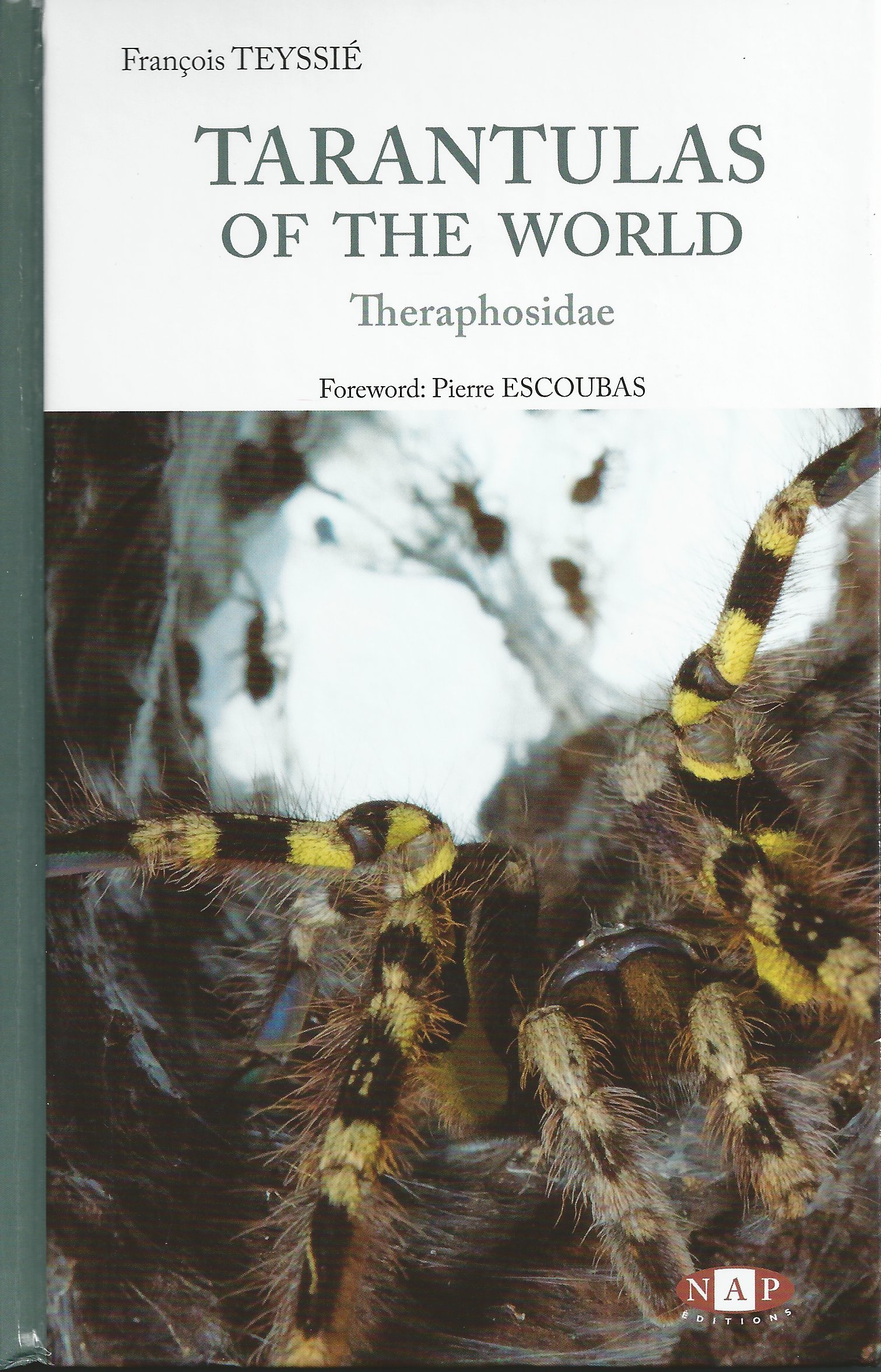
Just before Christmas of 2015 I became aware of two books that I found to be very exciting, “Tarantulas of the World” by Francois Teyssie and the subject of this review, “Scorpions of the World” by Roland Stockmann and Eric Ythier. It had been awhile since a new book on scorpions came out and despite its $95 price tag, I immediately bought it.

Though I primarily keep tarantulas, I have always found scorpions to be fascinating and I have always kept at least one species as pets. Most times scorpions seem to be covered in books having to do with arachnids in general such as “Arachnomania” by Philippe de Vosjoli and “Tarantulas and Scorpions In Captivity” by Russ Gurley. Finally here was a book that dealt with just scorpions and though it wasn’t a book designed for people who keep scorpions as pets, though it is covered briefly, I thought it would be a good reference book. I could not have been more right.

scorps

Continue reading BOOK REVIEW: Scorpions Of The World by Roland Stockmann and Eric Ythier

SHOOTING TARANTULAS…with a camera of course!

Having hobbies is what in many cases keeps us sane. It gives us a chance to relax and enjoy ourselves doing things that make us happy and help to forget how monotonous the real world can be. I have always been someone who has had many hobbies and they often seem to go in a cycle. Sometimes certain hobbies will be more important than others and then it will flip back again, oftentimes depending on my mood or even what time of year it is.

I have kept tarantulas since 1979 and have always had an interest in entomology. Growing up I would collect insects, mostly butterflies and moths, and I would pin them into display cases. As conservation became more important to me, so did the importance of insects being able to live out their lives in the wild. I decided that instead of capturing and displaying dead insects, I would switch and capture them on film instead. This is how my photography hobby began.

IMG_6411aHomeomma chilensis

Continue reading SHOOTING TARANTULAS…with a camera of course!

BOOK REVIEW: The Butterflies of Massachusetts by Sharon Stichter

Being a resident of Rhode Island, I have always wanted a field guide just on the butterflies indigenous to the littlest state in the union. As of this writing no such book exists so I have to be happy with more generalized field guides such as “Butterflies of the East Coast” by Rick Cech and Guy Tudor (reviewed HERE) or “A Swift Guide to Butterflies of North America” by Jeffrey Glassberg (reviewed HERE). Just recently I became aware of a book called “The Butterflies of Massachusetts,” by Sharon Stichter. Since Massachusetts is one of Rhode Island’s neighboring states, I figured this would be a pretty good book to have as many of the species between the two states should overlap.

MASSBUTTS

Continue reading BOOK REVIEW: The Butterflies of Massachusetts by Sharon Stichter

REHOUSING TARANTULAS: Poecilotheria metallica

Keeping tarantulas has always been a fun hobby for me and at the time of this writing, I have 55 tarantulas in my collection representing 44 species. They are fascinating animals and though they have the potential to bite, for the most part they are calm and make excellent pets. If you receive a tarantula as an adult, housing is relatively easy. You just place it into a size-appropriate enclosure and you should be all set with the exception of an occasional cleaning. When raising spiderlings though it is a different story since as they grow they need larger enclosures.

I start all spiderlings in deli cups with lids that have ventilation holes. For terrestrial (ground dwelling)species, I use a 16 oz. cup and for arboreals (live up off of the ground, usually in trees), I use a 32 oz. cup. These containers are small enough that it will make finding prey easy but at the same time large enough that the young tarantula can burrow if it wants or in the case of an arboreal species, be able to climb vertically. There is also enough room in these containers for a small water dish and regulating humidity is relatively easy.

IMG_5140

Continue reading REHOUSING TARANTULAS: Poecilotheria metallica

A Pictorial Guide To My Tarantula Collection

People are always asking me how many tarantulas I have and to be honest, I do have quite a few. What I am sharing with you today is the species list of tarantulas in my collection. In some cases I do have multiples of the same species so this list is just representative. In many cases, what I have are very young spiderlings so pictures may not be of the actual spider currently in my collection. As adult pictures of my actual animals are taken, they will replace any generic pictures used here. As more species are added, this list will be updated. Enjoy!

Acanthoscurria geniculata (Giant White Knee) – Brazil

dsadas

Continue reading A Pictorial Guide To My Tarantula Collection

BUTTERFLY CONSERVATION – Every Little Bit Helps

I have been a butterfly gardener for many years. Each year I try to add to existing gardens or take out gardens that don’t seem to be performing as well as I would like (when I say perform, I mean attracting butterflies). This year I wanted to do something new with an existing garden that over the past few years had just become overgrown, not only with weeds but with wildflowers and trees as well. This 13 foot by 13 foot garden had become unmanageable and with the exception of a butterfly bush and a wafer ash tree, nothing in it was attracting butterflies (the wafer ash was attracting giant swallowtails pretty regularly).

DSCF2914

Continue reading BUTTERFLY CONSERVATION – Every Little Bit Helps