Known commonly as Queen Alexandra’s Birdwing, Ornithoptera alexandrae is the largest butterfly on Earth. This spectacular insect is not just a marvel of size but a symbol of the fragile biodiversity found in the rainforests of Papua New Guinea. First discovered in 1906 by naturalist Albert Stewart Meek (who famously had to use a shotgun to bring down a specimen from the high canopy), it remains one of the most sought-after and endangered species in the world.
Continue reading The Queen of the Canopy: A Guide to Ornithoptera alexandraeThe Spiny Devil Walkingstick: A Guide to Eurycantha horrida
Commonly known as the Spiny Devil Walkingstick or the New Guinean Land Lobster, Eurycantha horrida is a formidable and fascinating member of the order Phasmatodea. Native to the tropical rainforests of Papua New Guinea—specifically the Popondetta region—this species has long been considered a “holy grail” for insect enthusiasts due to its impressive size, prehistoric appearance, and unique behaviors.
Continue reading The Spiny Devil Walkingstick: A Guide to Eurycantha horridaThe Striking Guatemalan Tiger Rump: A Guide to Davus pentaloris
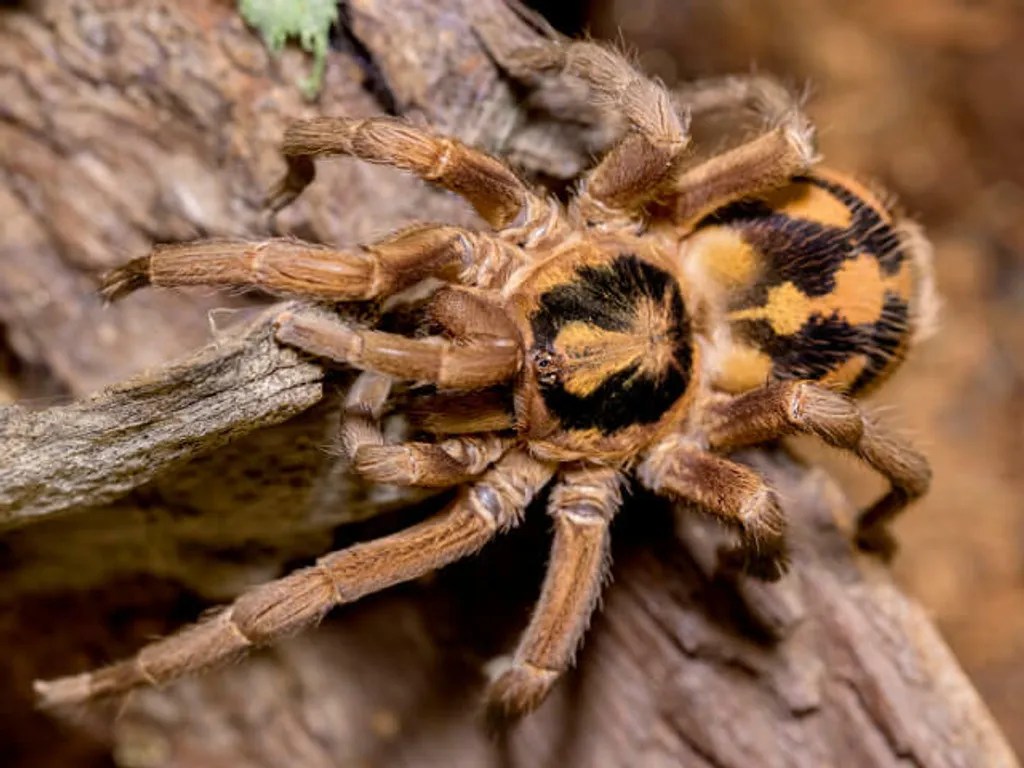
Among tarantula enthusiasts, Davus pentaloris (commonly known as the Guatemalan Tiger Rump) is celebrated as a “pocket-sized” masterpiece. While many large terrestrial tarantulas are shades of brown or gray, this species offers a vivid, high-contrast aesthetic that makes it a standout display animal in any collection.
Continue reading The Striking Guatemalan Tiger Rump: A Guide to Davus pentalorisThe Tarantula Enthusiast’s Bible: A Deep Dive into “Tarantulas in the Vivarium”
When Peter Klaas published Tarantulas in the Vivarium: Habits, Husbandry, and Breeding in 2001, the arachnoculture hobby was in a state of rapid transition. While keepers were moving away from “trial and error,” there was a desperate need for a consolidated, scientifically grounded resource.
Klaas, a respected German arachnologist and keeper, filled that void with a work that remains a foundational text for serious hobbyists and professional breeders alike.
Continue reading The Tarantula Enthusiast’s Bible: A Deep Dive into “Tarantulas in the Vivarium”The Crown Jewel of the Pampas: A Guide to Grammostola iheringi
Commonly known as the Entre Rios Tarantula or the Brazilian Black and Red, Grammostola iheringi is frequently cited as the “crown jewel” of its genus. While many Grammostola species are famous for being slow-moving “pet rocks,” G. iheringi breaks the mold with its massive size, striking velvet-black and burgundy coloration, and a surprisingly high-energy personality.
Continue reading The Crown Jewel of the Pampas: A Guide to Grammostola iheringiThe Greater Arid-Land Katydid: Nature’s Spiny Predator
While most people associate katydids with the gentle, rhythmic chirping of a summer evening, Neobarrettia spinosa—commonly known as the Greater Arid-Land Katydid or the Red-Eyed Devil—is a creature of a much more formidable nature. Found primarily in the southwestern United States and Northern Mexico, this insect is a striking example of predatory evolution within the Orthoptera order.
Continue reading The Greater Arid-Land Katydid: Nature’s Spiny PredatorThe Art of Playing Dead: The Secrets of the Blue Death-Feigning Beetle
Often appearing like a cluster of living blueberries on a desert floor, Asbolus verrucosus—commonly known as the Blue Death-Feigning Beetle—is one of the most charismatic and hardy invertebrates in North America. These beetles have become a sensation in the exotic pet trade, not only for their striking powdery-blue hue but for their dramatic “acting” skills and extreme longevity.
Continue reading The Art of Playing Dead: The Secrets of the Blue Death-Feigning BeetleThe Emperor of Arachnids: A Complete Guide to Pandinus imperator
Often called the “Gentle Giant” of the arachnid world, Pandinus imperator, or the Emperor Scorpion, is one of the most iconic and recognizable invertebrates on the planet. Native to the steaming rainforests and humid savannas of West Africa, it has earned a reputation for its massive size, striking ebony appearance, and surprisingly docile nature.
Continue reading The Emperor of Arachnids: A Complete Guide to Pandinus imperatorThe Museum in a Volume: Why Paul Smart’s Encyclopedia Remains the Gold Standard of Lepidopterology.
For enthusiasts of lepidopterology and vintage natural history books, few volumes command as much reverence as Paul Smart’s “The Illustrated Encyclopedia of the Butterfly World.” First published in 1975 (with the widely beloved 1985 reprint), this work remains a definitive cornerstone of entomological literature. It isn’t just a reference book; it is a visual love letter to one of nature’s most delicate and diverse orders.
Continue reading The Museum in a Volume: Why Paul Smart’s Encyclopedia Remains the Gold Standard of Lepidopterology.The Spiny Leaf Insect: A Masterclass in Natural Mimicry
The Extatosoma tiaratum, widely known as the Spiny Leaf Insect or Macleay’s Spectre, represents one of the most sophisticated examples of evolutionary camouflage in the animal kingdom. Originating from the diverse ecosystems of eastern Australia, ranging from tropical rainforests to temperate woodlands, this stick insect has developed a morphology that renders it nearly indistinguishable from a dried, shriveled leaf. Beyond its aesthetic appeal, it has become a favorite among entomologists and exotic pet enthusiasts due to its docile temperament and the fascinating biological processes it displays throughout its life cycle.
Continue reading The Spiny Leaf Insect: A Masterclass in Natural Mimicry