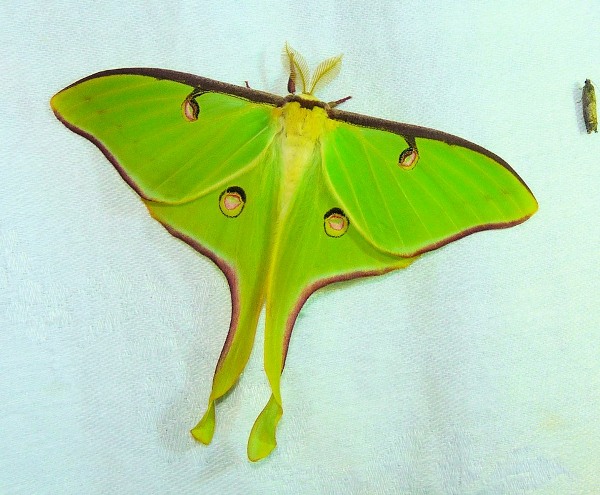
The Luna Moth (Actias luna) is one of the most spectacular of the giant Saturniid moths from the United States. With its green colors and long delicate tails, it is breathtaking to see live and in person, especially for the first time! According to the amazing book “The Wild Silk Moths of North America: A Natural History of the Saturniidae of the United States and Canada” by Paul M. Tuskes, James P. Tuttle and Michael M. Collins, this species can be found throughout most of the eastern part of North America. There are two seasonal forms, with those hatching in the spring being a more intense green in color whereas those hatching in the summer tend to be more yellowish. The spring forms also have a more vibrant purple outer wing margin. I have found them very easy to rear on both walnut and sweetgum, with the only real issues being overcrowding which tends to attract yellow jackets and birds, who love to eat the caterpillars, especially when using net bags on the branches of trees.
Continue reading LEPIDOPTERA LIFE CYCLES: The Luna Moth (Actias luna)All posts by David Albaugh
SPECIES SPOTLIGHT: Battus philenor, the Pipevine Swallowtail
Welcome to part one of a series I am doing called Species Spotlight. Each entry will showcase one particular species of invertebrate, whether it’s a butterfly, a moth, an arachnid or a millipede. Wherever possible I will use my own photographs and each entry will feature general information of the species as well as any additional notes that I can add, based on working with said species. The topic of this entry is the Pipevine Swallowtail, Battus philenor.

Continue reading SPECIES SPOTLIGHT: Battus philenor, the Pipevine Swallowtail
BOOK REVIEW: “Butterflies of Pennsylvania: A Field Guide” by James L. Monroe and David M. Wright
If you are a regular reader on here then you know that I love field guides. There are so many good ones out there that you just don’t know which one(s) to get. I have reviewed some of the better ones but to be honest, as good as they all are, none of them are perfect. Each field guide brings something pertinent to the table but they also miss the mark in other areas. I actually wish that someone would take the best elements of all of these guides and make one perfect guide.
Some guides try to be over ambitious, covering either the whole United States or just the east or west coast. These are all fine and good but the problem is, the more ambitious they are, the more likely they are to keep out important information because they want to minimize the overall size of the guide. Field guides are just that, guides meant to be used in the field. If they weigh ten pounds it makes it difficult to bring the book with you.
The Highly Underrated Grammostola pulchripes, the Chaco Golden Knee
With over 900 species of tarantula worldwide, most keepers are always on the look out for the new and exciting must-have species that just recently became available, after years of being absent from the hobby (or never available at all). Tarantulas that feature larger-than-usual sizes or stunningly beautiful colors are always in high demand and while this is fine and good, some staples of the hobby take a back seat. Other species, that should be popular, just never achieve that must-have status. The subject of this blog, in my opinion, is one such species.
Continue reading The Highly Underrated Grammostola pulchripes, the Chaco Golden Knee
Old World Versus New World Tarantulas
As of this writing there are 954 known species of tarantulas in the world, with dozens upon dozens of described genus names. As research continues on these fascinating animals, new genus and species names are created and animals are being shifted into new nomenclature. You just never know when what you had yesterday as a Brachypelma smithi could now be Brachypelma hamorii tomorrow. What one day was Avicularia versicolor is now Caribena versicolor. As new species are discovered and more research is done, I am sure these shifts will continue.
BOOK REVIEW: “The Book of Caterpillars” by David G. James
When I was approached in early 2015 to be a part of this book, I quickly agreed. How exciting would it be to be a part of a book that had not been attempted yet about one of my favorite subjects, butterflies and moths. Yes, there have been other books on caterpillars (most notably “Caterpillars of Eastern North America” by David L. Wagner and “Caterpillars in the Field and Garden” by Thomas J. Allen) but none can boast a world-wide variety of 600 species shown full size! That is exactly what “The Book of Caterpillars: A Life-Size Guide to Six Hundred Species from Around the World” has done!
Continue reading BOOK REVIEW: “The Book of Caterpillars” by David G. James
Setting Up A New Tarantula Enclosure
When you have as many tarantulas as I do, you tend to go with what is easy in terms of enclosures. Uniformity works best, not only because it makes feeding easier but also because in many cases, you can maximize space used (and most tarantula enthusiasts will concur that you just cannot have enough space). There are downsides to this though, especially if you really want to showcase a prize specimen.
For the most part, I use Exo-Terra Breeding Boxes (see review HERE). Their rigid construction allows for stacking which maximizes much needed shelf space. The problem is that they don’t really allow for your collection to be displayed properly. For housing a large variety of tarantulas, they are perfect; but if you want visitors to check out your collection, viewing them is difficult.
BOOK REVIEW: “Butterflies Across Cape Cod” by Mark Mello and Tor Hansen
Field guides are one of my favorite types of books, especially when it comes to insects. If you are a regular reader of my site you will know that I have actually reviewed quite a few here. The problem is there is a lot of rehash from guide to guide, oftentimes not offering any new info. If there’s nothing new to offer then why buy it?
Continue reading BOOK REVIEW: “Butterflies Across Cape Cod” by Mark Mello and Tor Hansen
KINGDOM OF THE SPIDERS: William Shatner Treks Through Tarantulas!
The 70’s were a special time for me. It was a great time to be a kid for so many reasons. I still vividly remember the cool toys like Micronauts and the 8″ Mego super-hero action figures (they are not dolls). Actually, pretty much any toy made by Mego at the time was cool! During this time there was also a constant availability of horror and monster movies to be seen on television.
This was also the time period that began my interest in entomology (the study of insects). Thanks to a Christmas gift of a kit for collecting butterflies and moths, I have had this interest ever since. Instead of actually collecting them now though, I am more into photography and conservation with them.
Continue reading KINGDOM OF THE SPIDERS: William Shatner Treks Through Tarantulas!
BOOK REVIEW: “Tarantulas: Breeding Experience & Wildlife”
This is such a great time to be a tarantula enthusiast. New exciting species are popping up all of the time and thanks to the internet, it is so easy to meet and talk to people with similar interests and experiences. Though there are many tarantula books out there, only a handful can really be described as exceptional. The subject of today’s review is one such book.
Continue reading BOOK REVIEW: “Tarantulas: Breeding Experience & Wildlife”