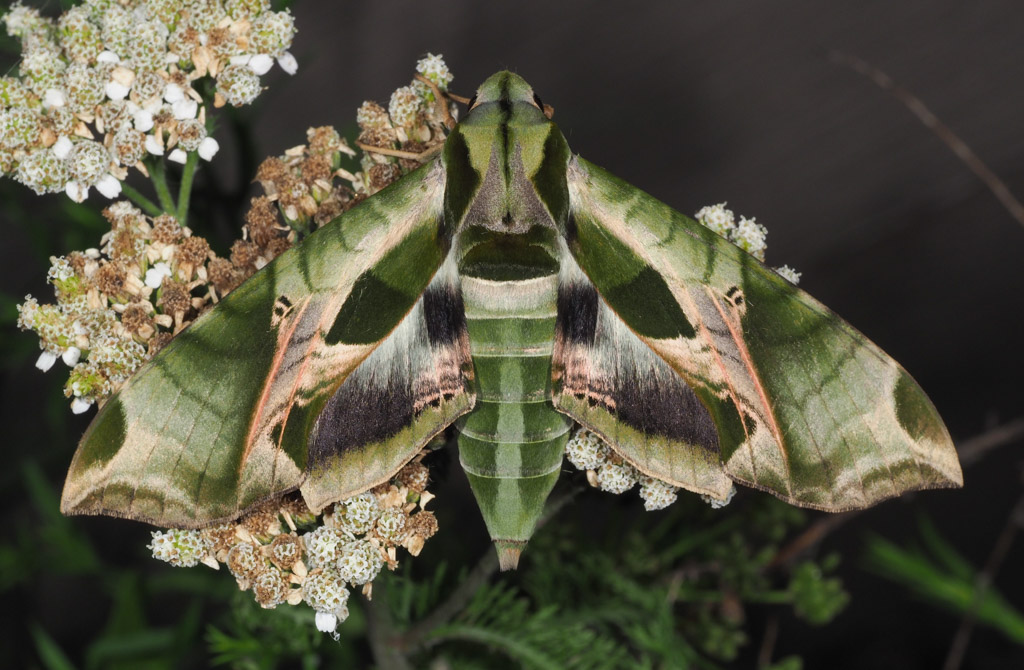

Eumorpha pandorus, commonly known as the Pandora Sphinx Moth, is among the most striking members of the family Sphingidae. Renowned for its sculpted, aerodynamic wings and rich, camouflage-like patterning, this species represents a classic example of insect specialization across eastern and central North America.
Physical Identification
The Pandora sphinx is a heavy-bodied, rapid flier with a wingspan typically ranging from 8.5 to 11.5 cm (3.3 to 4.5 inches).
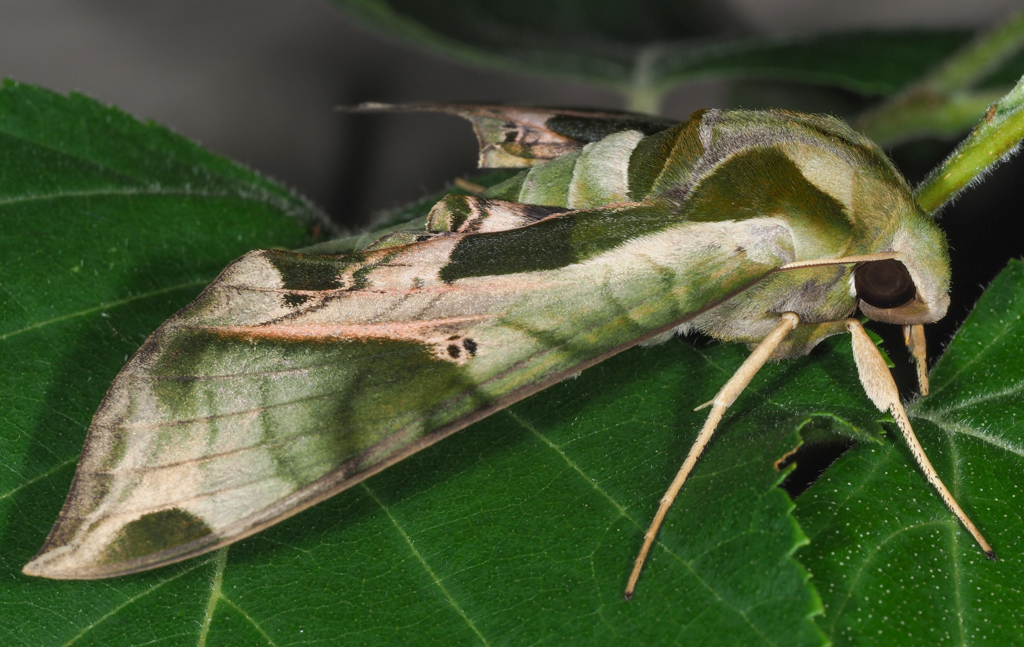
- Adult Coloration: The forewings showcase an intricate mosaic of muted olive green, slate gray, and velvety tan, accented by distinct dark olive-to-black patches along the margins. The smaller hindwings feature a delicate basal wash of pinkish-rose bordered by deep black banding.
- Streamlined Morphology: Like other hawk moths, its torpedo-shaped thorax and tapered abdomen support sustained, high-speed flight and stationary hovering.
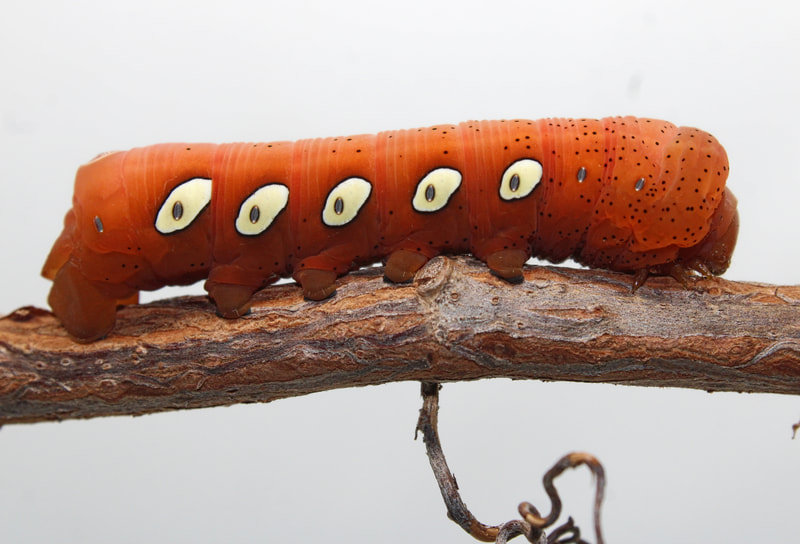
- Larval Dimorphism: Mature caterpillars grow up to 8 to 10 cm long and exhibit notable color polymorphism, appearing in vivid green, rust-orange, or deep chocolate brown.
Life Cycle and Metamorphosis
The life cycle transitions through dramatic morphological changes, particularly in the larval stages.
- Egg: Females deposit translucent, pale-green eggs singly onto the undersides of host plant foliage during early to midsummer.
- Early Instars: Young caterpillars possess a long, whip-like caudal “horn” typical of sphingid larvae. In early molts, this structure is curved and nearly half the length of the caterpillar’s body.
- Final Instar: In the fifth and final instar, the tail horn is shed completely and replaced by a shiny, raised, button-like caudal eye-spot. When alarmed, the larva tucks its head and first two thoracic segments backward into its swollen third segment, creating a swollen, snake-like silhouette framed by 5 to 6 oval, cream-colored spiracular patches.
- Pupation: Unlike silkmoths, E. pandorus does not spin a silk cocoon. Instead, the prepupal larva burrows several inches into loose soil or leaf litter, forming a smooth subterranean chamber where it transforms into a glossy, dark reddish-brown pupa to overwinter.
Ecology, Diet, and Habitat
| Aspect | Details |
|---|---|
| Host Plants | Strictly Vitaceae: wild grape (Vitis), Virginia creeper (Parthenocissus quinquefolia), and peppervine (Ampelopsis). |
| Adult Nectar Sources | Deep-throated blooms like petunias, bouncing bet (Saponaria officinalis), phlox, and evening primrose (Oenothera). |
| Flight Period | May through October depending on latitude; single-brooded in the north, double-brooded in the south. |
| Range | Nova Scotia south to Florida, extending west to Texas, Kansas, and Wisconsin. |
Adult Pandora sphinx moths fly predominantly at dusk and throughout the night. By hovering mid-air and deploying an elongated proboscis to access nectar in nocturnal flowers, they serve as crucial evening pollinators across temperate forest borders, riverbanks, and suburban gardens.


Leave a Reply