


Previously, for decades, virtually every orange-kneed tarantula in captivity and popular media was labeled Furthermore, Brachypelma smithi. In 2017, arachnologists Jorge Mendoza and Oscar Francke published a landmark taxonomic and molecular revision of the red-kneed Brachypelma complex in Invertebrate Systematics, revealing that two distinct species had been grouped under a single name—and that the vast majority of captive “Mexican Red-knee” tarantulas are actually Brachypelma hamorii.
Meanwhile, the true Brachypelma smithi turned out to be the tarantula hobbyists had been calling Brachypelma annitha (the Mexican Giant Red-knee), which Mendoza and Francke formally synonymized with B. smithi.

Taxonomic History and the 2017 Revision
Moreover, explaining why these two species remained confused for over a century means examining how handlers treated their type specimens.
- In 1897, British arachnologist F. O. Notably, Pickard-Cambridge described Brachypelma smithi from an immature male collected in Dos Arroyos, Guerrero, Mexico. Pickard-Cambridge described Brachypelma smithi from an immature male collected in Dos Arroyos, Guerrero, Mexico. Because juveniles lack developed sexual organs and full adult coloration, the diagnostic traits were ambiguous.
- However, Andrew M. Smith’s 1994 redescription mistook Colima, Mexico, specimens for B. smithi, though they were a separate northern species. Smith attempted to re-describe B. smithi using museum specimens from Colima, Mexico—unaware that spiders from Colima represented a separate northern species.
- 1997 — Parallel Descriptions: French researchers Marc Tesmoingt, Frédéric Cleton, and Jean Verdez described Brachypelma hamorii from Colima and Michoacán alongside Brachypelma annitha from Guerrero. Because the hobby had already cemented B. smithi as the name for the Colima/Michoacán spiders exported in the 1970s and 1980s, B. hamorii was largely overlooked as a synonym.
- 2017 — DNA Barcoding and Revision: Mendoza and Francke sequenced the COI gene alongside detailed morphological measurements. They found an 8% genetic divergence between the northern and southern populations—well above the ~4% threshold separating valid Brachypelma species. The true B. smithi from Guerrero matched B. annitha (making annitha a junior synonym), while the common pet-trade red-knee reverted to Brachypelma hamorii.

Geographic Isolation: The Balsas River Barrier
In the wild, Brachypelma smithi and Brachypelma hamorii never overlap. Their ranges along Mexico’s Pacific coast are physically split by the Balsas River basin (and the lower Atoyac River), which acts as a major biogeographic barrier:
- Brachypelma hamorii (North of the Balsas River): Endemic to the western slopes of the Sierra Madre Occidental and Sierra Madre del Sur across Colima, southeastern Jalisco, and northwestern Michoacán.
- Brachypelma smithi (South of the Balsas River): Restricted exclusively to the hilly deciduous tropical forests of Guerrero, from the southern edge of the Balsas basin down toward Acapulco.
External Visual Differences
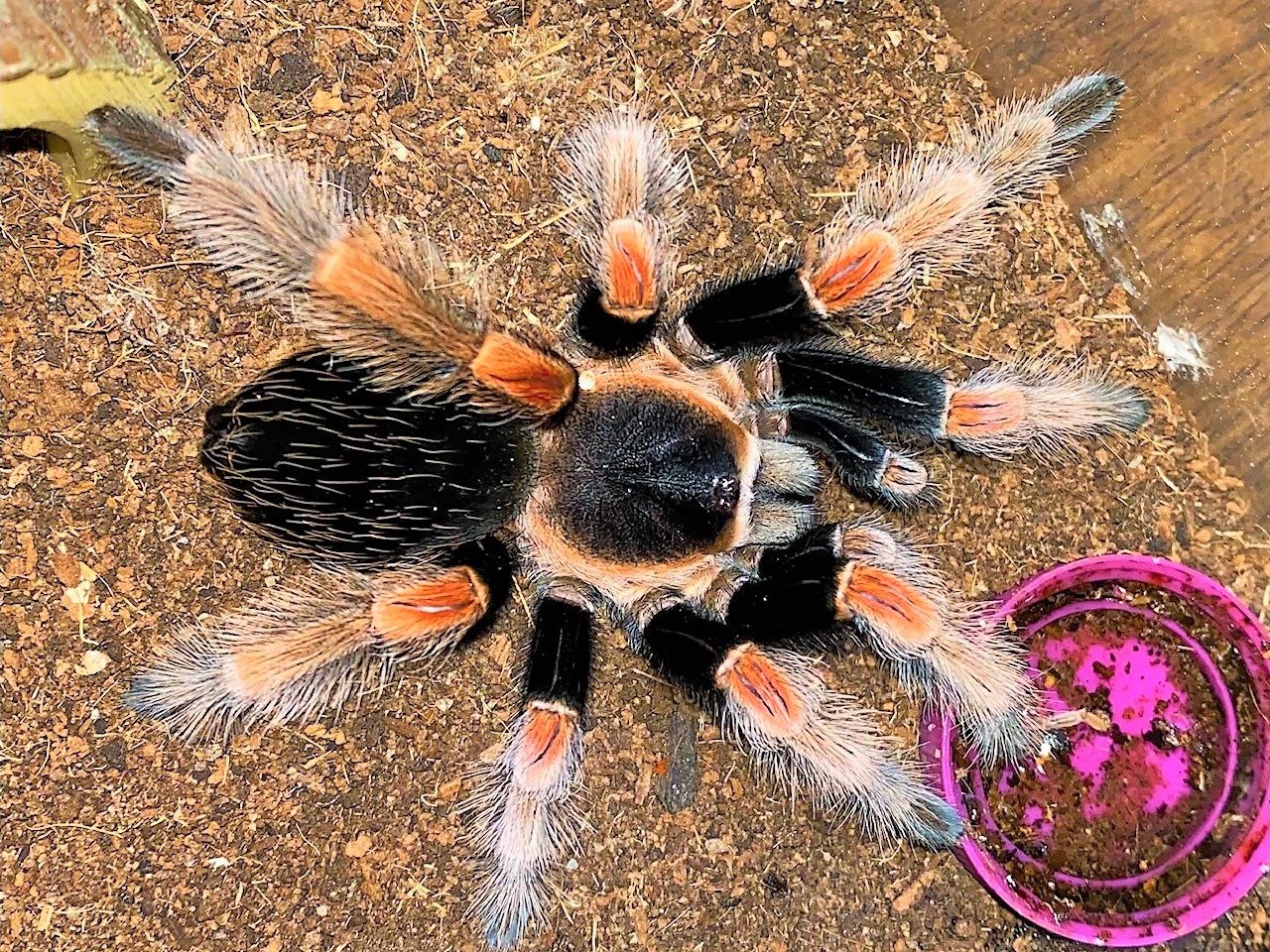
While both species share the iconic black-and-orange leg pattern and velvety black abdomen, inspecting a freshly molted adult reveals several reliable external markers:

1. Chelicerae (Jaws) — The Most Reliable External Clue
When viewed directly from above (dorsal view), the anterior face of the chelicerae shows a clear diagnostic difference:
- B. hamorii: Displays two distinct longitudinal brownish-pink or pale pinkish-gray bands running down a darker grayish-black background. These bands can fade in worn pre-molt individuals, so they are easiest to verify right after a molt.
- B. smithi: Completely lacks cheliceral bands. The upper surface of the chelicerae is uniform dark gray-brown to black.

2. Patellae (“Knees”) and Leg Setae
- B. hamorii: The orange “flame” patch on the dorsal surface of each patella is framed by black lateral sides. Furthermore, the long guard hairs (setae) along the legs are whitish, creating crisp contrast against the jet-black femora.
- B. smithi: The orange coloration wraps further around the lateral sides of the patellae and is noticeably deeper, brighter fiery orange-red. The long setae along the legs carry a warm yellowish tint rather than stark white.
3. Carapace Pattern and Adult Size
- B. hamorii: Features a prominent, well-defined black triangular mask extending forward from the fovea toward the eye tubercle, bordered by pinkish-beige to pale orange margins. Adult females generally reach a body length of 50–55 mm (approx. 2–2.2 inches) with a diagonal leg span around 5.5–6 inches.
- B. smithi: Grows noticeably bulkier and larger—earning its former hobby name “Mexican Giant Red-knee”—with adult females regularly reaching 60–70 mm in body length and leg spans pushing 6.5–7 inches. Its carapace tends to show brighter, warmer orange-peach border coloration with a slightly reduced or softer dark central patch.

Internal and Microscopic Diagnostic Traits
When external coloration is ambiguous—or when verifying specimens for conservation and CITES enforcement—taxonomists examine reproductive structures under magnification:
- Female Spermathecae (Inspectable on Molts):
- B. hamorii: The spermatheca sits on a single, continuous elliptical base plate, and its ventral (underside) surface is smooth.
- B. smithi: The spermathecal base plate is divided and sub-triangular, and the ventral surface features distinct grooves or striations.
- Mature Male Palpal Bulbs:
- B. hamorii: Viewed retro-laterally, the embolus is narrower, slightly more curved, and tapers to a narrow apical keel.
- B. smithi: The palpal bulb is straighter with a broad, spoon-shaped profile and a noticeably wider keel at the apex.
Captive Care and Husbandry Comparison
Because both species inhabit seasonally dry tropical deciduous forests along Mexico’s Pacific coast, their captive care requirements are nearly identical, with only minor differences in enclosure sizing and temperament:
- Enclosure Size: Both are slow-moving terrestrial burrowers that thrive in enclosures offering plenty of floor space rather than height. House adults in a 10-to-15-gallon enclosure (at least 16″ × 10″ × 10″), providing extra floor space for large female B. smithi specimens that approach a 7-inch leg span.
- Substrate and Moisture: Provide 4–6 inches of dry, packed substrate (such as a mix of coco fiber, organic topsoil, and excavator clay) so they can excavate a starter burrow. Keep the enclosure predominantly dry with a shallow, constantly filled water dish; slightly overflowing the water dish once every 2–3 weeks maintains adequate localized moisture without creating stagnant humidity.
- Temperature and Humidity: Maintain ambient temperatures between 72°F and 80°F (22°C–27°C) and relative humidity around 55%–65%.
- Temperament and Handling: Both species are famously docile, hardy, and slow-growing, making B. hamorii the gold-standard beginner tarantula. While B. smithi is equally calm, it can be slightly more prone to kicking urticating hairs when startled and is significantly more expensive and harder to source as a verified pure specimen.

Side-by-Side Comparison Summary
| Diagnostic Feature | Brachypelma hamorii | Brachypelma smithi |
| Former / Hobby Name | Sold as B. smithi (1970s–2017) | Sold as B. annitha (1997–2017) |
| Native Distribution | North of Balsas River (Colima, Jalisco, Michoacán) | South of Balsas River (Guerrero) |
| Chelicerae (Top View) | Two brownish-pink longitudinal bands | Uniform dark gray/black (no bands) |
| Patella Lateral Sides | Black | Orange |
| Leg Guard Setae | Whitish | Yellowish |
| Adult Female Leg Span | 5.5–6 inches | 6.5–7 inches |
| Female Spermatheca | Elliptical baseplate; smooth ventral face | Divided subtriangular baseplate; striated ventral face |
| Male Palpal Bulb | Narrower, curved, narrow apical keel | Straighter, broad spoon shape, wide apical keel |
| Captive Availability | Very common; staple of the pet trade | Uncommon; prized by Brachypelma specialists |
| Conservation Status | IUCN Vulnerable; CITES Appendix II | IUCN Near Threatened / Vulnerable; CITES Appendix II |
To read my other articles on Tarantulas, click HERE.
Leave a Reply