
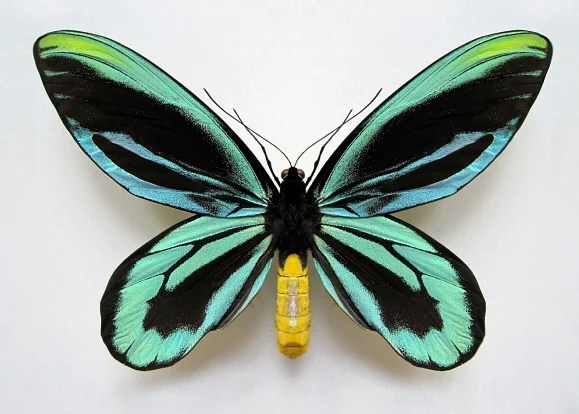
Known commonly as Queen Alexandra’s Birdwing, Ornithoptera alexandrae is the largest butterfly on Earth. This spectacular insect is not just a marvel of size but a symbol of the fragile biodiversity found in the rainforests of Papua New Guinea. First discovered in 1906 by naturalist Albert Stewart Meek (who famously had to use a shotgun to bring down a specimen from the high canopy), it remains one of the most sought-after and endangered species in the world.

1. Physical Characteristics and Sexual Dimorphism
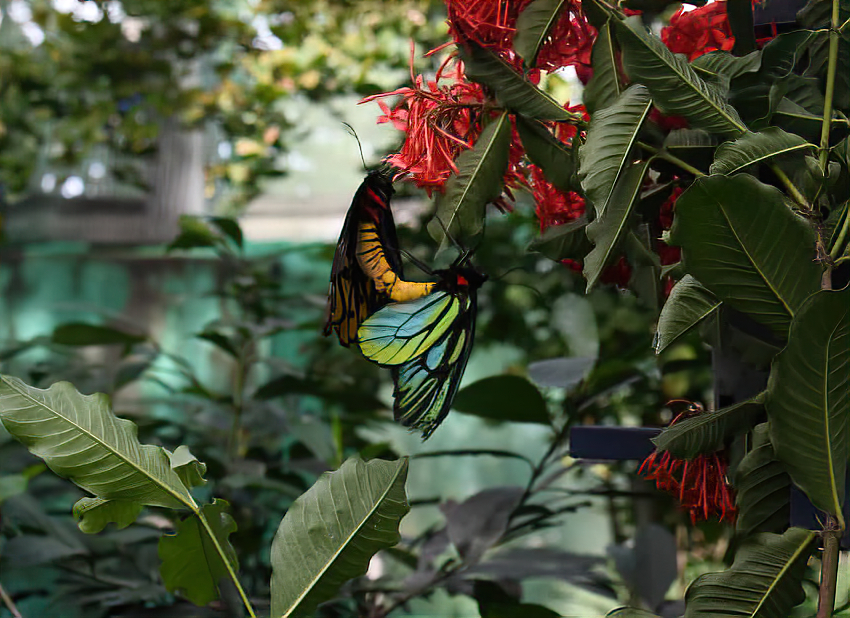
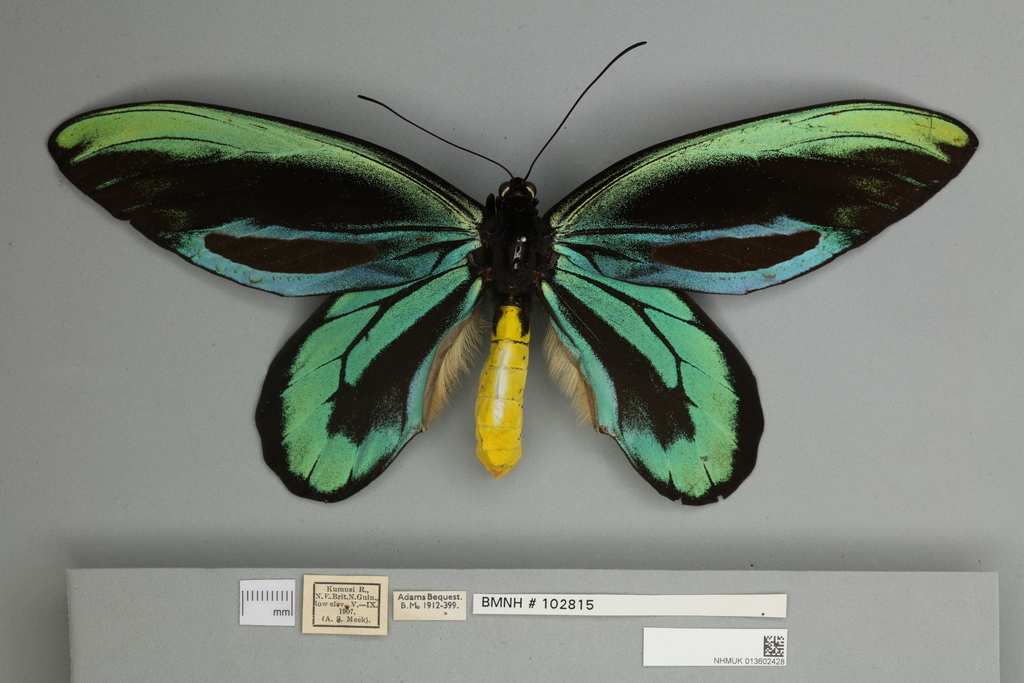
This species exhibits extreme sexual dimorphism, meaning the males and females look so different they could almost be mistaken for separate species.
| Feature | Female | Male |
| Wingspan | Up to 25–30 cm (approx. 11 inches) | 16–20 cm (approx. 7–8 inches) |
| Coloration | Dark chocolate brown with cream/white markings | Iridescent electric blue-green with black bands |
| Body Color | Cream-colored abdomen; red tuft on thorax | Bright yellow abdomen |
| Wing Shape | Broad and rounded | Angular and pointed |
The female’s sheer mass is significant for a butterfly, with a body length of about 8 cm and a weight of up to 12 grams.
2. Habitat and Distribution
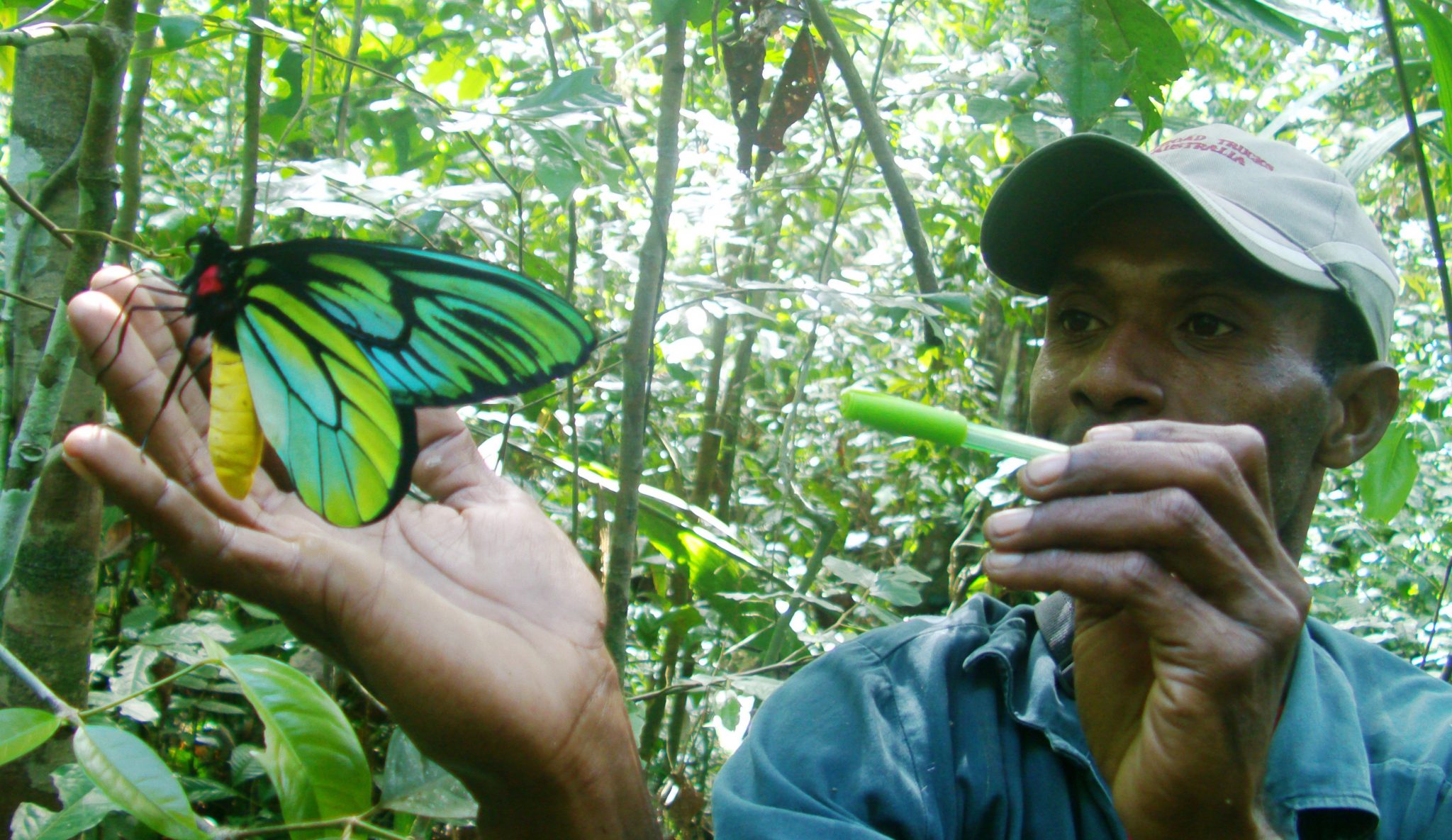
The Queen Alexandra’s Birdwing is a micro-endemic species, found in an incredibly small area of eastern Papua New Guinea.
- Location: Restricted to the Oro Province, specifically the Popondetta Plain and the Managalas Plateau.
- Total Range: Its habitat is estimated to be fragmented into just 100–140 square kilometers.
- Environment: It thrives in primary and secondary lowland rainforests. Unlike many smaller butterflies, it is a “canopy dweller,” spending much of its life 20–40 meters above the ground, descending only to feed or lay eggs.

3. Life Cycle and Biology
The butterfly has an intimate, specialized relationship with the Pipevine plant (genus Pararistolochia).
- Egg: The female lays large (4 mm) eggs on the underside of pipevine leaves.
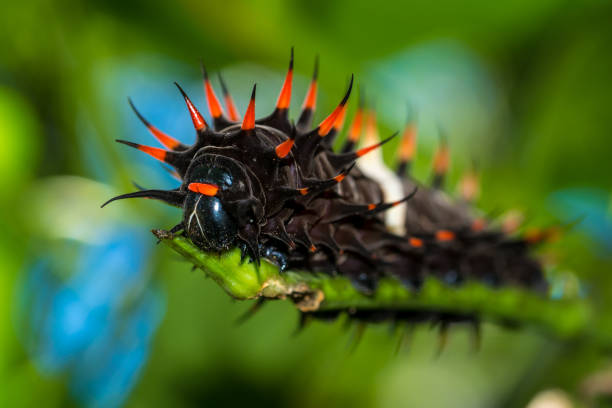
- Larva (Caterpillar): Upon hatching, the caterpillar is black with bright red fleshy spikes (tubercles) and a cream-colored “saddle.” It feeds exclusively on the pipevine, which contains aristolochic acids.
- Self-Defense: By consuming these toxins, the caterpillar becomes poisonous to predators, a trait it retains into adulthood.
- Pupa: The chrysalis is golden-yellow or tan. This stage lasts about a month.
- Adult: Emerging in the high humidity of the early morning, adults can live for 3 to 4 months. They are powerful fliers and highly territorial; males have been known to chase away small birds that enter their space.
4. Conservation Status and Threats
The IUCN classifies Ornithoptera alexandrae as Endangered. Its survival is balanced on a knife-edge due to several factors:
- Habitat Loss: The primary threat is the expansion of the palm oil industry and large-scale logging, which destroys the old-growth forests and the specific vines the butterfly needs to survive.
- Natural Disasters: The 1951 eruption of Mount Lamington wiped out a massive portion of its primary habitat.
- The Black Market: Because of its beauty and rarity, specimens are highly prized by collectors. A single specimen can fetch thousands of dollars on the illegal market, despite being protected under CITES Appendix I, which strictly prohibits international trade.
Conservation Efforts
Current efforts focus on captive breeding programs and working with local communities to plant more Pararistolochia vines. Some conservationists advocate for “butterfly farming,” which would allow locals to legally sell a limited number of specimens to create a financial incentive for protecting the forest.
Captive breeding and community-led conservation are the current “front lines” in the fight to save the Queen Alexandra’s Birdwing. Because the butterfly lives high in the canopy and is extremely rare, traditional conservation (like simply fencing off a park) hasn’t been enough.
Here are the most significant active projects and modern strategies being used in Papua New Guinea as of 2025–2026:
1. The Dun Eco-Tourism & Nursery Project (Yoivi Village)
One of the most promising recent initiatives is the Dun Eco-Tourism Project in Yoivi village, Oro Province.
- The Nursery: Led by local volunteer Ahi Matue (working with the National Volunteer Service), this project has established a dedicated breeding nursery specifically for O. alexandrae.
- Method: Instead of just protecting wild butterflies, the project actively breeds them in a controlled environment to increase survival rates of larvae, which are often decimated by predators in the wild.
- Community Integration: The project recently made headlines in 2025 for its “ClimateLaunchpad” success, which seeks to turn the butterfly into a sustainable economic asset for the 2,000+ people of Yoivi through eco-tourism rather than illegal trade.
2. The Swallowtail and Birdwing Butterfly Trust (SBBT) & NBPOL
The SBBT has partnered with New Britain Palm Oil Limited (NBPOL) to create a specialized laboratory at the Higaturu palm oil estate. This is a unique “industrial-conservation” partnership:
- The Goal: To create a “win-win” where palm oil estates set aside high-value conservation areas within their land specifically for the butterfly.
- Habitat Enrichment: They focus on planting thousands of the Pararistolochia dielsiana (the butterfly’s specific food vine) to create “corridors” that connect fragmented patches of forest.
- Scientific Support: The lab provides entomological expertise to ensure the genetic health of the populations being bred and released.
3. Genomic Mapping for Population Management
A major scientific breakthrough in 2023–2025 involved the first chromosome-scale assembly of the butterfly’s genome.
- Why it matters: Researchers discovered that the two known populations (the lowland Popondetta group and the highland Managalas Plateau group) are genetically distinct and have been separated for about 10,000 years.
- Current Action: Breeding projects now use this data to ensure they don’t accidentally “cross” the two populations, which could lead to outbreeding depression and further weaken the species.
Discover more from
Subscribe to get the latest posts sent to your email.
 davethebugguy.org