

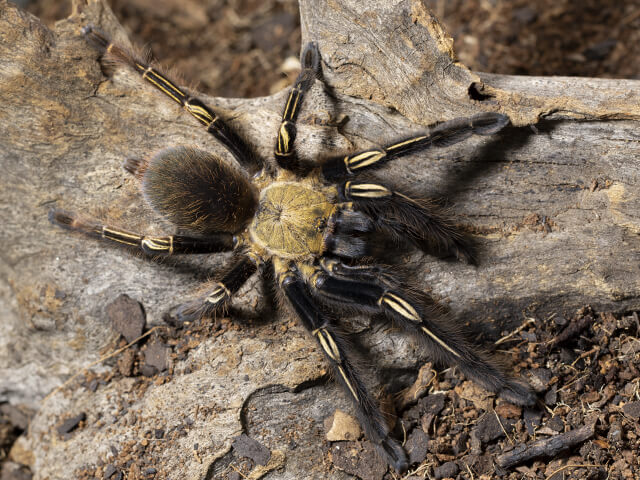
The Skeleton Tarantula (Ephebopus murinus) is one of the most visually striking and biologically unique arachnids in the hobby. Named for the brilliant, cream-colored markings on its knees that resemble a skeletal structure, this species is a favorite among experienced keepers.
However, beneath its “bony” exterior lies a complex predator with behaviors that defy standard tarantula classifications.

Taxonomy and Natural Habitat
Ephebopus murinus belongs to the subfamily Schismatothelinae. Unlike many of its cousins in the Ephebopus genus, which are often semi-arboreal, the Skeleton Tarantula is a dedicated fossorial (burrowing) species.
- Origin: Primarily found in the humid rainforests of Northern South America, specifically Brazil, Guyana, Suriname, and French Guiana.
- Environment: They inhabit the dark, moist forest floor, where they construct deep, silk-lined burrows among the root systems of tropical trees.
Physical Characteristics
The Skeleton Tarantula is medium-sized, reaching a diagonal leg span of approximately 11 to 13 cm (4.5 to 5 inches).
Key Visual Identifiers:
- The “Skeleton” Markings: The most famous feature is the stark white or yellowish longitudinal stripes on the patellae (knees), contrasting against a dark brown or black velvet body.
- The Carapace: Often displays a shimmering golden or olive-tan hue.
- The Abdomen: Generally dark and covered in fine hairs.
The Anatomical Oddity: Urticating Hairs
Most New World tarantulas have irritating (urticating) hairs on their abdomens which they kick at predators. E. murinus is unique: it possesses urticating hairs on its pedipalps (the small arm-like appendages near the mouth). When threatened, it rubs its palps against its fangs to eject these hairs—a behavior more commonly seen in Old World species, despite this being a New World spider.

Behavior and Temperament
If you are looking for a “pet rock,” this is not the spider for you. The Skeleton Tarantula is known for being skittish, defensive, and incredibly fast.
- Defensive Nature: They do not hesitate to throw a “threat posture” (rearing up to show fangs) if disturbed.
- Fossorial Lifestyle: In captivity, they are master architects. They will spend most of their time underground, emerging primarily at night to hunt.
- Speed: Their burst of speed is comparable to arboreal species, making re-housing a task for focused, experienced keepers.

Husbandry Requirements
Successfully keeping E. murinus requires mimicking the constant humidity of the Amazonian floor.
1. Housing
- Substrate: Depth is the most critical factor. Provide at least 15–20 cm (6–8 inches) of a moisture-retaining mix (coco fiber, peat moss, and topsoil).
- Orientation: Use a terrestrial enclosure with more depth than height to prevent fall injuries.
2. Temperature and Humidity
- Temperature: Aim for 24°C to 28°C (75°F – 82°F).
- Humidity: High levels are required (75–85%). The substrate should be kept damp (but not swampy) throughout the lower layers. Good ventilation is essential to prevent mold growth in these humid conditions.
3. Diet
They are voracious eaters. Slings (spiderlings) accept flightless fruit flies or pinhead crickets, while adults thrive on:
- Dubia roaches
- Crickets
- Superworms
Summary Table
| Feature | Specification |
| Common Name | Skeleton Tarantula |
| Type | New World Fossorial (Burrower) |
| Growth Rate | Medium to Fast |
| Venom | Mild (Typical of New World) |
| Difficulty | Intermediate to Advanced |
| Longevity | Females: 12-15 years | Males: 3-4 years |
The Skeleton Tarantula is a rewarding species for those who appreciate naturalistic “bio-active” setups and the mystery of a fossorial predator. While you may not see them every day, the sight of those white-striped legs peeking out from a silk-lined burrow is well worth the effort.
Discover more from
Subscribe to get the latest posts sent to your email.
 davethebugguy.org