

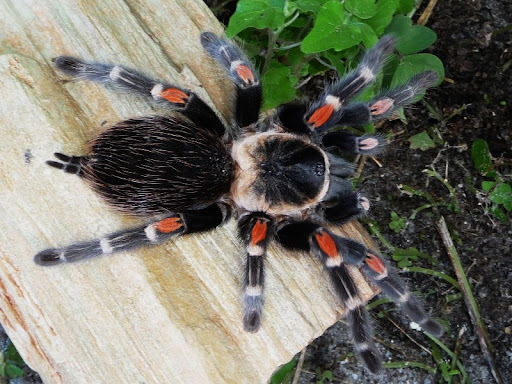
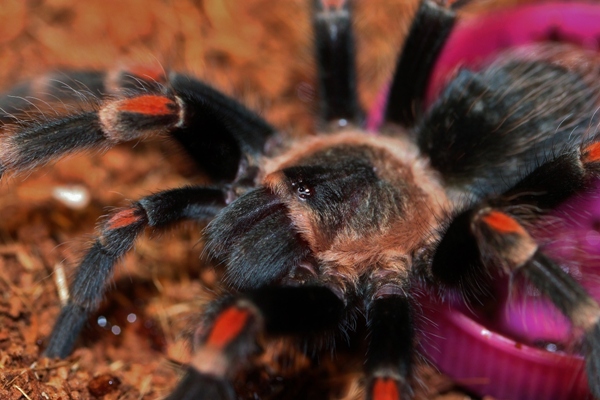
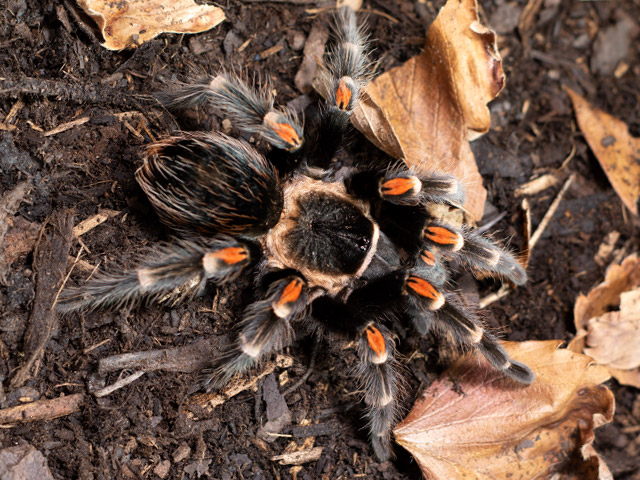
The Mexican Flame Knee Tarantula, Brachypelma auratum, is a visually striking species of New World terrestrial tarantula known for its vibrant black coloration accented by fiery red-orange markings on its patellae (knees). Its history is intertwined with the broader understanding and classification of the Brachypelma genus, particularly its close resemblance to the well-known Mexican Red Knee tarantula, Brachypelma hamorii (formerly often referred to as Brachypelma smithi).
Early Recognition and Confusion
For many years, Brachypelma auratum was not recognized as a distinct species. Instead, it was often considered a “highland form” or variation of Brachypelma smithi due to their superficial similarities in appearance, including the characteristic red markings on the legs. This made accurate identification challenging for hobbyists and even some researchers.
Formal Description and Naming (1992)
The formal scientific description of Brachypelma auratum occurred in 1992 by Dr. Günter Schmidt. This was a significant step in clarifying the taxonomy of the Brachypelma genus. Schmidt’s description was based on a dead male specimen and the exuvia (molted skin) of a female. The name “auratum” is derived from the Latin word “auratus,” meaning “golden,” which likely refers to the golden hue on the carapace or the distinctive golden-orange flame-like patterns on its knees that give it its common name. The type locality is presumed to be Sinaloa, Mexico, although its known distribution now extends to Guerrero and Michoacán in Mexico.
Taxonomic Revisions and Conservation Status
The taxonomy of Brachypelma has seen several revisions over the years. In 2017, a major review, partly using molecular data, led to the reclassification of several Brachypelma species into the newly erected genus Tliltocatl. However, Brachypelma auratum remained within the genus Brachypelma, reaffirming its distinct place among the “red-kneed” tarantulas.
Due to the beauty and docile nature of Brachypelma species, they became highly sought after in the pet trade. This led to significant pressure on wild populations through illegal collection. Recognizing this threat, Brachypelma smithi (which at the time was not distinguished from B. hamorii) was placed on CITES Appendix II in 1985. In 1994, all remaining Brachypelma species, including B. auratum, were added to CITES Appendix II. This listing restricts international trade and aims to regulate collection to protect wild populations. Despite these regulations, smuggling of wild-caught tarantulas, including B. auratum, continues to be a concern.
Habitat and Ecology
Brachypelma auratum is native to the Pacific coastal regions of Guerrero and Michoacán in Mexico. It inhabits the Balsas dry forest ecoregion, a habitat characterized by hot, dry conditions. These tarantulas are terrestrial, burrowing under tree roots and large stones to escape extreme temperatures. Interestingly, they have been observed living communally with a small frog species, Eleutherodactylus occidentalis, which may aid in pest control around the tarantula’s burrow.
Cultural Significance and Hobby Popularity
The Mexican Flame Knee tarantula’s stunning appearance and generally docile temperament have made it a popular species among tarantula enthusiasts. Its vibrant colors make it a captivating display animal. The long lifespan of females (25-30 years, sometimes up to 40 years) also contributes to its appeal as a long-term pet. The emphasis in the hobby is now on captive breeding to reduce the demand for wild-caught specimens and support conservation efforts.
In summary, the history of Brachypelma auratum is one of delayed recognition, leading to its formal description in 1992, followed by its integration into CITES regulations to combat overcollection for the pet trade. It stands as a testament to the ongoing discovery and conservation challenges within the diverse world of tarantulas.

Discover more from
Subscribe to get the latest posts sent to your email.
 davethebugguy.org