
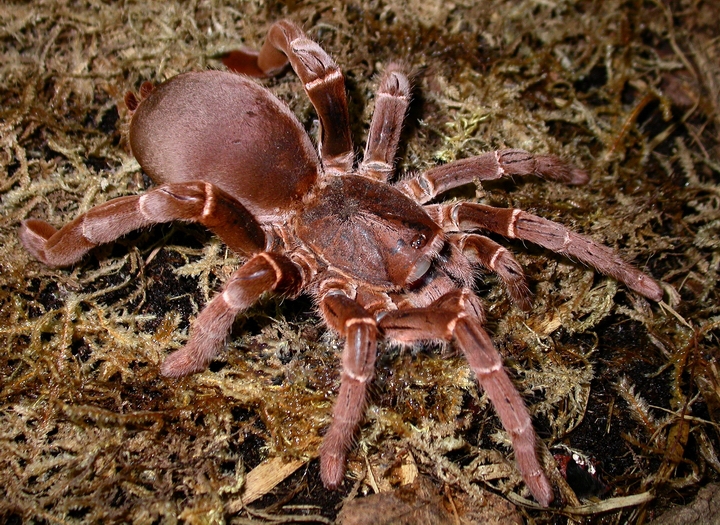
Pelinobius muticus, commonly known as the King Baboon Spider, is a fascinating and formidable tarantula species. Here’s a detailed look at its characteristics, behavior, and care:
Scientific Classification and Origin:
- Scientific Name: Pelinobius muticus
- Genus: Pelinobius
- Family: Theraphosidae
- Origin: East Africa, primarily Tanzania and Kenya.
- Notably, the Pelinobius Genus is monotypic, meaning that Pelinobius muticus is the sole species within that Genus.
Physical Characteristics:
- This tarantula is one of the larger Old World species, boasting a leg span that can reach up to 9 inches (approximately 23 centimeters).
- It has a robust and heavy build, well-adapted for its burrowing lifestyle.
- Its coloration is typically a rusty brown to orange, giving it an earthy and camouflaging appearance.
- A notable feature is its stout hind legs, designed for efficient digging.

Behavior and Temperament:
- Pelinobius muticus is known for its highly defensive nature.
- Unlike some tarantulas, it lacks urticating hairs (defensive hairs), relying instead on its potent venom and a strong bite.
- A key defensive mechanism is stridulation, where it produces a hissing sound by rubbing its legs together.
- It is a fossorial species, meaning it spends the majority of its life in deep burrows.
- They are generally nocturnal hunters.
Habitat and Burrowing:
- This species inhabits the dry scrublands and savannas of East Africa.
- It constructs elaborate burrows that provide protection from predators and the harsh environment.
- These burrows can be quite extensive, creating complex tunnel systems.

Care in Captivity:
- Pelinobius muticus is generally considered an advanced tarantula species, not recommended for beginners.
- They require a deep substrate to facilitate their burrowing behavior.
- * Care must be taken when maintaining them, due to their defensive nature and powerful bite.
- Because they are an Old World Tarantula, bites from them can cause more intense pain than that of New World Tarantulas.
- They are slow-growing, which means patience is required when keeping this species.
- They require dry substrate conditions.
- Ventilation is also very important.
- Providing a place for them to burrow is of the upmost importance.
Key Considerations:
- Due to their defensive nature, handling is strongly discouraged.
- Their potent venom can cause significant pain.
- Their slow growth rate requires long-term commitment from keepers.
- * Breeding can be difficult.
Pelinobius muticus, or King Baboon Spider, is a remarkable tarantula species with unique characteristics and behaviors. While it presents challenges for keepers, it is also a fascinating subject of study and observation for those with the appropriate experience.
Discover more from
Subscribe to get the latest posts sent to your email.
 davethebugguy.org